
Serving Anoka, Hennepin, Ramsey, Washington, Scott, Dakota & Carver Counties
What Is a CMDE Assessment in Minnesota? The Evaluation Behind EIDBI Therapy


Quick Answer
What is a CMDE assessment? It is the Comprehensive Multidisciplinary Evaluation Minnesota requires before a child under 21 can begin EIDBI autism therapy. A qualified clinician reviews your child’s history, observes your child, interviews you and writes the report that shows intensive treatment is medically necessary. For most families, it is the step that turns a diagnosis into an approved plan.
At a glance
- What it is: An assessment used to establish whether EIDBI services are medically necessary.
- Who it serves: Individuals under age 21 with autism or a related condition.
- Who performs it: a qualified clinician who meets Minnesota DHS requirements
- How often: updated at least every three years, with one per year allowed without extra authorization
- What comes out of it: a written report and a DHS form sent for medical necessity review
Table of Contents
Why Does EIDBI Require a Comprehensive Multidisciplinary Evaluation for Autism?
Because EIDBI pays only for treatment documented as medically necessary, and the CMDE is that documentation. A diagnosis alone does not establish eligibility. Our guide explains what EIDBI is and how the benefit works. This article focuses on the evaluation needed to begin the process.
A comprehensive multidisciplinary evaluation for autism does two jobs. It confirms your child needs intensive intervention, and it gives the treatment team a baseline for the Individual Treatment Plan (ITP). The requirement comes from Minnesota Statutes section 256B.0949, and the Department of Human Services (DHS) explains the details in its EIDBI Benefit Policy Manual.
Many parents expect a one-time test. A CMDE is closer to a clinical file. It pulls together the diagnosis, your child’s strengths and needs, medical history, and your own priorities.
Who Is Eligible? CMDE Eligibility for EIDBI in Minnesota
CMDE eligibility for EIDBI depends on age, a qualifying condition, and coverage. Your child needs all of these:
- Younger than 21
- A diagnosis of autism or a related condition, or a condition that is currently being evaluated.
- A CMDE that shows medical necessity
- Medical Assistance, MinnesotaCare, TEFRA, or another qualifying program
What usually triggers a referral? One of four things:
- A concern raised by a pediatrician, teacher, or family member, sometimes following early signs of autism in toddlers.
- A child has a diagnosis but no CMDE yet
- The current CMDE is three years old and needs updating
- A transition at school or a significant change in your child’s needs.
Unsure about your child’s next step? Our team can help you understand the process. Talk with our intake team before you gather paperwork, and we will point you to the right starting place.
How Can I Get Started With an EIDBI Referral Form?
Anyone can start the process by sending an EIDBI referral form, including a parent, case manager or school professional. You do not need a finished diagnosis or a stack of records first. A coverage card and any existing reports are enough to begin.
Where Does the CMDE Fit in the Autism Diagnosis Process in Minnesota?
It comes after screening and, when needed, alongside the diagnostic assessment. In Minnesota, the typical autism diagnosis pathway begins with screening during a well-child visit, followed by a diagnostic evaluation and then a CMDE. The Minnesota Autism Resource Portal describes screening and identification.
When a child has no diagnosis yet, the CMDE can also serve as the diagnostic assessment. If you are comparing local options, see our guide to finding an autism evaluation near you.
How Is a CMDE Different From an Autism Diagnostic Evaluation or a School Evaluation?
Each evaluation answers a different question.
| Evaluation | Question it answers | Typical use |
| Autism diagnostic evaluation | Does my child have autism? | Establishes the diagnosis |
| CMDE | Is intensive treatment medically necessary? | Opens EIDBI services |
| School evaluation (IEP) | Does my child need educational supports? | Sets school services |
A school evaluation cannot replace a CMDE, and a CMDE does not create an IEP. Many children need more than one.
What Happens During a CMDE Assessment?
Three things: an observation, a review of your child’s medical evaluation, and an interview with you. Most evaluations at our center take one or two appointments, with standardized tools added when a diagnosis is needed.
Who Performs a CMDE?
A licensed physician, advanced practice registered nurse, physician assistant, mental health professional, or another clinician who meets DHS qualification rules. A developmental pediatrician is one example of a physician who can do it. You can choose your CMDE provider, and the provider must be enrolled with Minnesota Health Care Programs. Learn about our evaluation process and scheduling options on our CMDE assessments page.
Who Observes My Child, and Is a Medical Exam Required?
The CMDE provider personally observes your child within 60 days of the CMDE date, in person or by telehealth. A trainee cannot replace the required observation by a qualified professional.
The medical piece surprises many parents. DHS requires a medical evaluation by your child’s physician or nurse practitioner within the past 12 months. The CMDE provider retrieves it, but it has to exist first. If your child’s last well-child visit was more than a year ago, book one before the CMDE. It keeps the file from stalling.
Is the ADOS-2 required for a CMDE?
Not for every CMDE. A trainee cannot replace the required observation by a qualified professional. The DHS manual recommends autism-specific tools such as the ADOS-2 but does not make them mandatory in every case. The ADOS-2 and ADI-R become mandatory only for certain benefit decisions, such as waiver or SSI determinations.
The report can also note co-occurring conditions, such as ADHD, anxiety or language delay, that shape how the treatment plan is written.
What Will the Provider Ask Me?
You are the primary source of information. The provider interviews a parent or caregiver, in person or by telehealth, about development, daily routines, sensory needs, communication, and your goals. DHS requires providers to consider your language and cultural needs and arrange an interpreter when necessary.
Bring these to the interview:
- Prior evaluations, school reports, or IEP documents
- Your child’s insurance card
- Recent medical records or the name of your child’s physician
- A short list of your top three concerns
How Do I Prepare My Child for the Appointment?
Keep it low pressure. Tell your child in simple words that they will meet someone who wants to play and talk. Bring a favorite toy or snack, keep to your usual routine that day, and plan a quiet activity afterward. The provider is there to see your child as they really are, so there is nothing to rehearse.
Is a Virtual Evaluation or an In-Person CMDE Better?
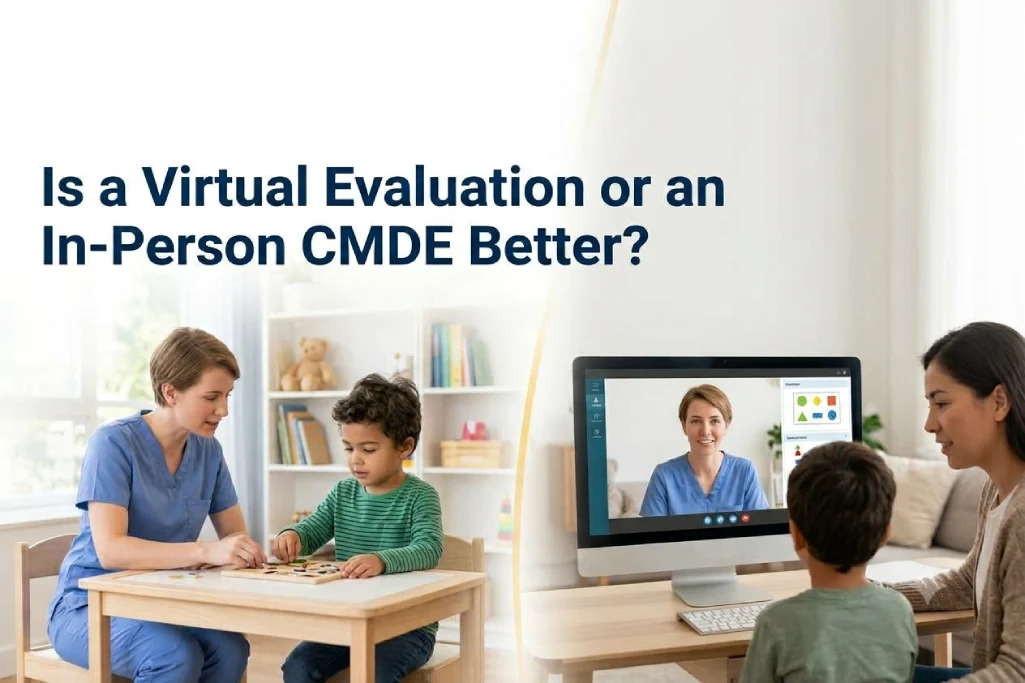
Neither is better by default. The right format depends on your child’s age, the tools needed, and your home setup. DHS allows the observation and parent interview to happen by telehealth, and a virtual evaluation can save travel for families across the Twin Cities area.
| Virtual evaluation | In-person evaluation | |
| Best for | Tight schedules, families far from a clinic | Children who need hands-on testing |
| What to prepare | Quiet room, stable internet, toys within reach | Travel time, a calm plan for the day |
| Trade-off | The provider sees your child at home, not in a clinic | More travel and scheduling |
What Happens After the CMDE? Coordinated Care Conference and ITP
The provider sends your results for medical necessity review, then the team builds your child’s ITP. The steps look like this:
- You receive a copy of the CMDE within 30 days of completion.
- You and the provider sign the DHS form, which goes to the state’s medical review agent or your child’s health plan.
- After approval, a qualified supervising professional writes the ITP.
- The ITP is finalized at the first coordinated care conference, a meeting for your family, providers, and school staff.
The ITP names goals, treatment type, and service intensity, and it is reviewed at least every six months. See how we build an individual treatment program.
What If the Review Says My Child Does Not Qualify?
You have options. Ask the provider to walk you through the decision, and check the notice from DHS or your health plan, which explains how to appeal. A CMDE can be requested again if your child’s needs change, and families can ask for one at any time.
How Long Is a CMDE Valid?
It must be updated at least every three years, or sooner when clinically necessary. One CMDE per year is allowed without extra authorization.
What Is the Evaluation Timeline From Referral to Therapy Start?
Minnesota does not publish one statewide timeline, so ask every provider for theirs in writing. Here is what is set by rule or by our own practice:
| Stage | What sets the pace |
| Referral to first reply | Our team typically responds within one to two business days |
| Evaluation | Most take one to two appointments. |
| Observation | Must happen within 60 days of the CMDE date |
| Report to family | Copy due within 30 days of completion |
| Medical necessity review | Set by the state’s medical review agent or your health plan |
| ITP and start of services | Depends on authorization and the coordinated care conference |
In our experience, delays rarely come from the evaluation itself. They come from a missing medical evaluation, unconfirmed coverage, or an unsigned form. Fix those first, and the evaluation timeline gets shorter.
Have a referral or a diagnosis in hand? Send us a referral and we will tell you what happens next.
Does Insurance Cover a CMDE, and Can I Use One From Another Provider?
Yes for coverage: Medical Assistance members with qualifying coverage are covered when an MHCP-enrolled provider completes the CMDE. Confirm your child’s plan before booking.
Often yes for transfers: a current evaluation can usually be reused when you change agencies. Send it to us and we will review it, or see how to transfer an existing CMDE. Our FAQs page covers more everyday questions.
Why Trust This Guide
This article was prepared and clinically reviewed by [CLINICIAN NAME, CREDENTIALS] at Elite Services Center Inc. The process details come from DHS and Minnesota statute. Program rules change, so confirm current requirements with DHS or your county before you act.
Conclusion
So, what is a CMDE assessment? It is the evaluation that connects a diagnosis to funded treatment. The evaluation establishes medical necessity, provides your child’s care team with a clear foundation, and informs the Individual Treatment Plan (ITP) that guides treatment. Most delays trace back to three fixable things: a missing medical evaluation, unconfirmed coverage and unsigned paperwork.
Understanding what happens at each stage can make the process feel more manageable. You do not have to know everything before getting started. Simply be prepared to describe your child’s everyday experiences and the concerns you have noticed.
Ready to Take the Next Step for Your Child?
You have already done the hardest part, which is finding out what the process looks like. Our team will meet you where you are, whether you have a diagnosis, a referral or only a question, and we will walk you through each step.
Take the next step today: Call 612-298-2897 to schedule a CMDE or submit a referral. Would you prefer to understand our services first? Explore our care options to learn more.
Elite Services Center Inc
Schedule a conversation: Schedule a conversation
Address: 2021 E Hennepin Ave Ste 187
Minneapolis, MN 55413
Phone: 612-298-2897
Email: Info@eliteservices.centermail: Info@eliteservices.center